
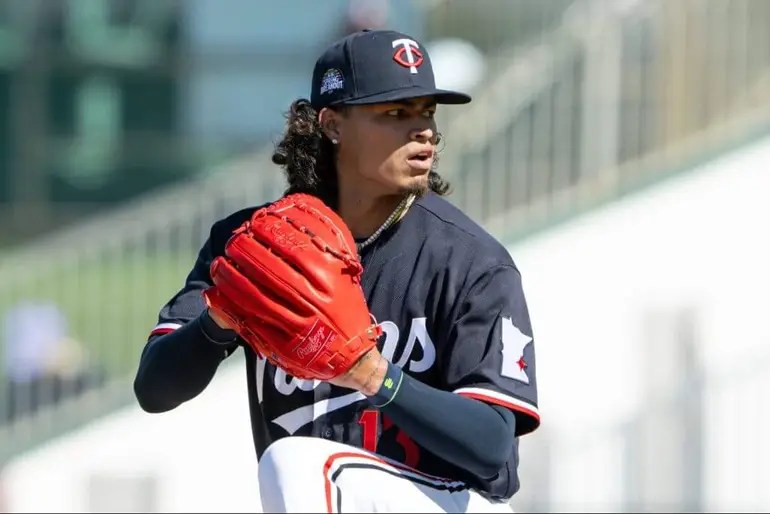
Marco Raya, a 2020 fourth-round draft pick, learned late Tuesday he is finally headed to the majors. (AP Photo/Benjamin Rush)
MINNEAPOLIS — A necessary discussion to rein in Marco Raya’s high-octane stuff occurred in late April.
A month into the season, a Minnesota Twins prospect was struggling to command pitches at Triple-A St. Paul. Even though the organization placed a premium on strike-throwing and trusting his nasty pitch mix during big-league camp in spring training, Raya wasn’t making gains as everyone hoped.
In fact, Raya was worse than ever.
A pitcher who’d averaged four walks per nine innings for his career opened the 2026 season by increasing that total to 6 1/2.
Sensing more direction was needed, the Twins suggested a few minor mechanical changes along with a major adjustment in pitch usage.
A former starting pitcher who converted to the bullpen in August, Raya was still throwing six different pitch types when the season began. The Twins suggested he reduce the number of pitches he threw to three while still occasionally turning to a fourth.
Two months later, Raya is throwing more strikes than ever. As a result, the 2020 fourth-round draft pick learned late Tuesday he was finally headed to the majors.
“It’s the best stretch (he’s had) in terms of throwing strikes, ability to execute pitches,” Twins manager Derek Shelton said. “He’s been on the radar for the last week or so, in terms of giving him an opportunity. With this situation we’re in with our pitching right now, it seemed like the right time.”
The timing of Raya’s promotion speaks to the depth of the challenge he and the Twins faced.
Knowing there would be ample opportunity in the bullpen after last season’s trade deadline gutted the group, Raya was mentioned by Twins front office members as a potential relief option early in the offseason. It wasn’t hard to envision Raya’s 97 mph fastball and nasty off-speed pitches making an impact in the majors.
Raya just needed to throw more strikes than he had as a starter.
Still, development doesn’t always go as planned. Despite showing flashes of effectiveness, Raya didn’t throw enough strikes and was optioned out of big-league camp on March 9.
“Transitioning to the bullpen was a little bit challenging,” Raya said, citing a difference in routine.
The Twins thought eliminating the majority of his repertoire could make the challenge easier for Raya to handle and suggested the change a month into the season.
Raya previously threw a four-seam fastball, two-seam fastball, cut-fastball, curveball, sweeper and changeup. The Twins asked him to ditch the two-seamer and the cutter while occasionally using the changeup against lefties.
“When I stopped throwing (the cutter) as often, everything started to get a little bit sharper,” Raya said.
The difference was astounding.
Working with the full array of pitches through May 2, Raya threw only 62.5 percent strikes. The lower ball-to-strike ratio resulted in shorter outings as he issued 11 walks versus 15 strikeouts with a 9.98 ERA in his first 15 1/3 innings.
After he made the switch, Raya threw 70.5 percent strikes. Not only could he pitch deeper into games, but Raya also issued just one walk and struck out 24 over 23 2/3 innings pitched, posting a 2.66 ERA.
“Once he started getting on a roll and did a really good job of filling up the strike zone, I do think it made it easier from a buy-in perspective for him to continue it and continue to get some momentum,” said Twins minor-league pitching development director Tommy Bergjans.
Raya said feeling good mechanically and trusting his stuff are making all the difference.
“Just caught a rhythm,” Raya said. “Concentrating on my work and trusting my work and just going out there and throwing the ball. … The mechanical fixes and change of direction, being more direct toward the plate, really helped me find the zone.”
That rhythm opened the Twins’ eyes. The conversation shifted to when it would be appropriate for the Twins to bring Raya to the majors rather than whether they should at all.
Raya arrives in the big leagues at a time when the Twins require more stability out of their lower-leverage relievers.
The team is in a better place now in the late innings, with Anthony Banda regaining his velocity and the emergence of Yoendrys Gómez and Andrew Morris in the late innings.
The Twins are still struggling to find consistency throughout the rest of the group.
If he can continue to throw strikes, Raya might be able to carve out a niche similar to what Morris did in April. The Twins believe Raya’s pitch mix is one of the best in the organization as he pairs an upper-90s fastball with a curve and sweeper that generate swings and misses.
For now, he might want to get some rest. The 23-year-old said his call to the majors arrived late Tuesday night as he was preparing to fall asleep, which led to a restless evening.
“Pretty sick feeling,” Raya said. “I can’t really put into words what that feels like. Pretty crazy. … I didn’t sleep at all.”

 jbballsports.com